
Radon Levels in Lubbock, TX: What the Data Shows
The sourced local numbers: submitted test results, the EPA zone map, and the soil and housing-stock reasons behind them, laid out with their caveats intact.
How high is radon in Lubbock? The honest answer starts with a caveat: submitted radon test results for Lubbock average 12.7 pCi/L, more than three times the EPA's 4.0 pCi/L action level. But that number comes from a small, self-selected sample of about ten homes, submitted mostly by owners who already suspected a problem. It isn't a citywide average, and it isn't proof your specific house is high: it's directional evidence, a reason to test, not a substitute for testing. Here's what the data shows, where it comes from, and what it doesn't tell you.
| 12.7 | pCi/L average of submitted Lubbock tests (small, self-selected sample) |
|---|---|
| 4.0 | pCi/L, the EPA action level for fixing a home |
| 9 to 15 | pCi/L range of individual submitted Lubbock results |
| 1984 | median build year of Lubbock's housing stock |
What do Lubbock's submitted radon tests actually show?
Submitted radon tests for Lubbock average 12.7 pCi/L, with individual results ranging roughly 9 to 15 pCi/L, according to RadonResources' Lubbock Metro data. That average comes from a small, self-selected set of about ten homes, so treat it as directional evidence, a strong reason to test, not a citywide figure.
The 12.7 pCi/L figure comes from a small set of submitted results (roughly ten homes) collected by RadonResources for its Lubbock Metro market page, which also reports a broader area figure closer to 12 pCi/L. Individual results in the sample run roughly 9 to 15 pCi/L: every one above the EPA's 4.0 pCi/L action level, and some well above it.
What this data can't tell you is how common high readings are across every home in Lubbock, because homeowners who submit results to a data-aggregation site are rarely a random sample. People test (and report) when they already suspect a problem: a musty basement, an inspection flag, a neighbor's high reading. That's exactly why the number is worth taking seriously rather than literally. It's a strong signal Lubbock homes can run high. It isn't a citywide average.
Isn't Lubbock only EPA Zone 2?
Yes, the 1993 EPA Map of Radon Zones puts Lubbock County in Zone 2, predicting a county average of 2 to 4 pCi/L. Texas has zero Zone 1 counties. But a Zone 2 label was never meant to mean safe: the EPA's own guidance says every home should be tested, regardless of zone.
The EPA's radon zone map was published in 1993 and sorts every U.S. county into one of three zones based on predicted average indoor radon levels, using aggregated soil, geology, and historical data available at the time. Zone 1 counties are predicted to average above 4 pCi/L; Zone 2 counties, including Lubbock, are predicted to average 2 to 4 pCi/L. No Texas county carries a Zone 1 rating. The entire state tops out at Zone 2.
That's a county-level statistical prediction, not a guarantee about any individual house: levels vary block to block based on the soil beneath a specific foundation. The EPA has never treated a Zone 2 or Zone 3 rating as a reason to skip testing, and Lubbock's submitted readings are a real-world illustration of why that guidance exists.
Why do West Texas soils produce radon?
Radon comes from uranium and radium decaying naturally in soil and rock, then off-gassing through soil pores into homes where indoor air pressure is lower than the soil beneath. The caliche and limestone-rich soils common across the South Plains around Lubbock provide a real, physical radon source, not a marketing claim.
Radon is a naturally occurring, colorless, odorless gas produced when uranium and radium in soil and rock decay. It moves through pore spaces and cracks in soil as a gas, and homes create a pressure difference (indoor air pressure typically runs slightly lower than the air in the soil beneath the foundation), which pulls that gas upward through foundation cracks, sump pits, and utility penetrations, much the way a slightly deflated tire pulls in outside air.
The caliche and limestone-rich soils across the South Plains aren't a marketing detail. They're a real geological source term. These calcium-carbonate soils and the rock beneath them carry enough uranium and radium to generate a meaningful radon supply, with a porous structure that gives the gas a path to move. That doesn't mean every Lubbock home has a problem. It means the region has the raw ingredients for one, consistent with what the submitted test data shows.
Does Lubbock's housing stock make it worse?
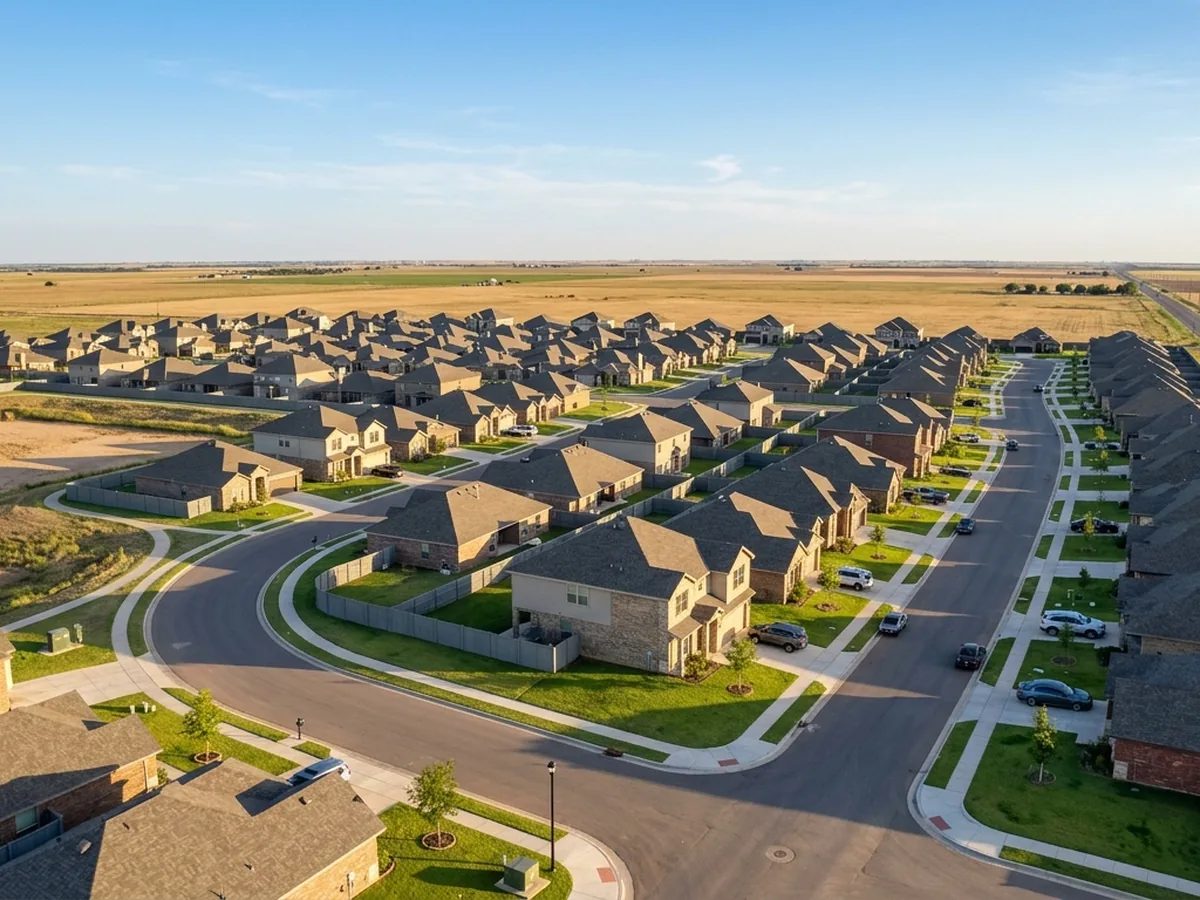
Lubbock's median home was built in 1984, and the city's foundation mix includes slab, partial and full basements, and crawlspaces, an unusual spread for Texas, where slab-on-grade dominates. Older slabs develop cracks radon can enter through, and basements add more below-grade wall and floor surface in contact with soil.
A median build year of 1984 means a large share of Lubbock's homes are now over 40 years old, and concrete slabs develop hairline cracks and gaps around plumbing penetrations as they age and settle, each one a potential entry point for soil gas.
Foundation mix matters too. Most of Texas is slab-on-grade country, but Lubbock has a real mix of slab, partial and full basements, and crawlspaces. Basements put more foundation wall and floor area in direct soil contact; crawlspaces let soil gas collect underneath and migrate into the living space above. None of these are radon-proof or radon-guaranteed, but they do call for different mitigation approaches, which is why a professional test and a system designed for your specific foundation matter more than a one-size-fits-all fix.
How do I find out my home's number?
Free short-term test kits are available through the Texas Radon Program at Texas Tech (depts.ttu.edu/ceweb/radon), mailed out weekly per local news coverage. If a real-estate deal needs documented results, a professional test (roughly 48 hours, about $275 locally) produces a certified report buyers, sellers, and lenders can rely on.
Two paths get you a real number. The Texas Radon Program at Texas Tech University mails free short-term test kits to Texas residents on a rolling basis. Local news coverage has reported kits going out weekly. You place the kit, leave it undisturbed for the required period, and mail it to a lab for results.
If you're buying, selling, or refinancing and need a result a lender or title company will accept, a professional short-term test is the standard: about 48 hours with a calibrated device, run by someone independent of any mitigation sale. Locally listed pricing for a certified test runs around $275. Either path answers the question that actually matters: your home's own number.
When are Lubbock levels highest?
Radon levels typically peak during the winter heating season, when closed windows and running furnaces widen the pressure difference between a home's interior and the soil beneath it, pulling more soil gas indoors. January is National Radon Action Month, timed to when testing matters most nationwide.
Homes are tightest (and radon levels tend to run highest) during winter, when windows stay closed and furnaces run more, both of which increase what's called the stack effect: warm air rising and escaping through the upper levels of a house, pulling replacement air in from below, including through the foundation. That's part of why national guidance points to winter testing.
That doesn't mean testing in July is pointless: radon can be present year-round, and a professional test follows a closed-house protocol specifically to produce a reliable reading regardless of season. But if you have flexibility in timing, testing during the coldest months gives you the closest look at worst-case conditions.
What should you do with this data?
If you haven't tested yet, start with radon testing options for Lubbock homes, free and professional. If you already have a high reading, radon mitigation explains how a system brings it down. Or head back to the Lubbock Radon home page.
Get connected with a Lubbock radon pro
Three fields, no spam, no obligation. Or skip the form: (806) 329-4585.
We pass your info to one local radon professional so they can contact you about your request: nothing else, no lists, no resale.
Sources
Every figure on this page is sourced. Nothing here is estimated or invented.
- RadonResources (Lubbock Metro): submitted local test-result data (average, range, sample basis)
- EPA Map of Radon Zones (Texas): county-level zone predictions and methodology
- Texas Radon Program, Texas Tech University: free short-term test kits
- CDC (Radon Testing Guidance): testing protocol and seasonal recommendations